
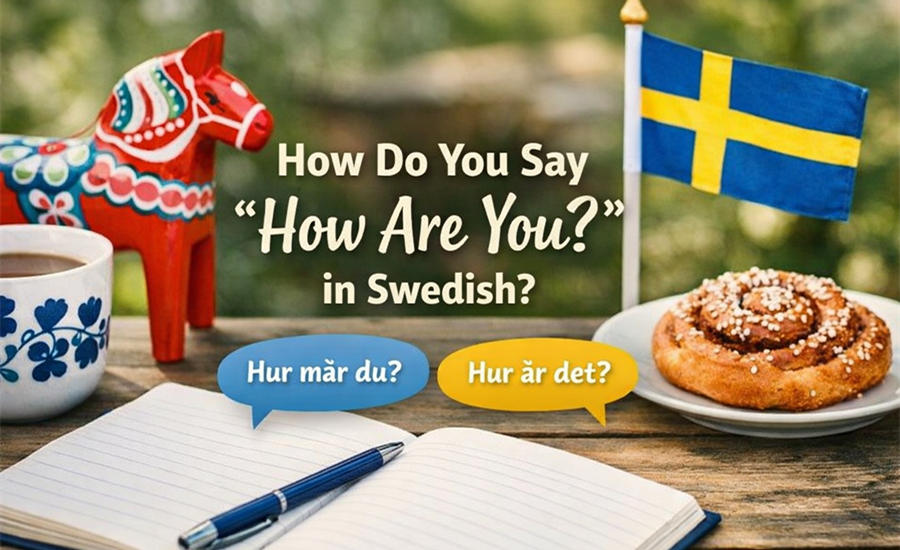
If you want to say “how are you” in Swedish, the good news is that it is not hard once you know the most natural options. The two best phrases to learn first are Hur mår du? and Hur är det?. Both are common, both sound natural, and each one gives you an easy way to start a real conversation without sounding too stiff or too textbook.
The Quick Answer to “How Are You” in Swedish
The simplest answer is this: if you want a safe, beginner-friendly phrase, use Hur mår du?. If you want a very natural everyday option, use Hur är det?.
They are both useful, but they do not feel exactly the same.
Hur mår du? is closer to asking how someone is doing or feeling. It feels warm, clear, and direct.
Hur är det? is a little broader. In conversation, it often feels more like “how’s it going?” or “how are things?” That makes it especially useful in relaxed daily speech.
So if you came here hoping for one exact Swedish translation of “how are you,” the better answer is that Swedish gives you a few natural choices. What matters most is not picking the most literal phrase. It is picking the one that sounds right in the moment.
Common Ways to Say “How Are You” in Swedish
Hur mår du?
Hur mår du? is one of the first Swedish phrases many learners pick up, and for good reason. It is simple, natural, and easy to use in real life. If you want one phrase that clearly means “how are you?” this is a very strong place to start.
- Meaning: How are you? / How are you feeling?
- Tone: Friendly, direct, and natural
- Best for: Everyday conversation, especially when you want to ask about the person directly
- Pronunciation: Roughly “hur mohr doo”
This phrase works well with friends, people you know, and general beginner practice. It feels personal in a warm way, not overly serious. If you are checking in with someone and genuinely want to know how they are doing, this is a very comfortable choice.
It is also easy to remember because it maps fairly neatly to the English idea of asking how someone is. That makes it one of the safest phrases to keep in your back pocket when you are just starting out.
Hur är det?
Hur är det? is another very common way to ask how someone is doing, and in many situations it sounds a little more relaxed than Hur mår du?. Literally, it is closer to “how is it?” but in real conversation it works more like “how’s it going?” or “how are things?”
- Meaning: How’s it going? / How are things?
- Tone: Relaxed, open, and everyday
- Best for: Casual daily conversation
- Pronunciation: Roughly “hur air deh”
This is a very useful phrase because it sounds natural without trying too hard. It is not formal, and it does not feel overly emotional either. It simply opens the door to conversation in an easy, everyday way.
If Hur mår du? feels a little more like “how are you feeling?”, then Hur är det? often feels more like “how are things with you?” That subtle difference is exactly why it helps to learn both.
Hur står det till?
Hur står det till? is also correct and still useful to know, even if it may not be the very first phrase you use. Learners often come across it in phrase lists and beginner materials, and you may hear it in conversation too.
- Meaning: How are things? / How are you?
- Tone: Polite and a little more set than the first two
- Best for: Recognizing another common way Swedish speakers may phrase the question
- Pronunciation: Roughly “hur stor deh till”
Compared with Hur är det?, this one can feel slightly less casual depending on the speaker and situation. Not dramatically formal, just a little more fixed in its wording. That is why many beginners understand it before they actively start using it.
You do not need to make this your main phrase, but it is worth recognizing. Once you know it, Swedish conversation starts to feel much less repetitive and much more natural.
Hur är läget? / Läget?
Hur är läget? is more casual, and the shorter Läget? is even more relaxed. In English, the feeling is closer to “how’s it going?” or even “what’s up?” than to a careful classroom version of “how are you?”
- Meaning: How’s it going? / What’s up?
- Tone: Casual and conversational
- Best for: Friends, informal chats, and relaxed everyday speech
- Pronunciation: Roughly “hur air LEH-get” or simply “LEH-get?”
This is a great phrase to recognize because it makes spoken Swedish feel more real. It is the kind of wording that sounds easy and natural once you are a little more comfortable with the language.
If you are completely new to Swedish, you do not need to start here. But once you already know Hur mår du? and Hur är det?, this is a nice next step that helps your Swedish feel less textbook and more conversational.
How to Reply When Someone Asks You in Swedish
Once you know how to ask the question, the next step is learning a few easy replies. The good thing is that Swedish answers do not need to be long. In most cases, a short reply sounds the most natural.
- Bra, tack — “Good, thanks.” Simple, useful, and easy to remember.
- Jag mår bra — “I’m doing well.” A natural reply when someone asks Hur mår du?
- Det är bra — “It’s good” or “Things are good.” A very everyday kind of answer.
- Så där — “So-so.” Good for those in-between days.
- Inte så bra — “Not so good.” Short, honest, and straightforward.
- Och du? — “And you?” The easiest way to keep the conversation going.
If you want one full reply that works in almost any beginner situation, go with Bra, tack. Och du? It is one of those little phrases that immediately makes you sound more comfortable in conversation.
You can also make your answer match the question naturally. If someone says Hur mår du?, replying with Jag mår bra feels smooth and direct. If they say Hur är det?, replying with Det är bra feels just as natural.
The Best Way to Remember It
If you do not want to memorize too much at once, keep it very simple. Start with these three phrases:
- Hur mår du?
- Hur är det?
- Bra, tack. Och du?
That is already enough for a basic Swedish conversation.
After that, you can add one more casual option like Hur är läget? so your Swedish starts to sound a little more relaxed and flexible. You do not need every version right away. It is much better to know a few phrases well than to collect too many and never use them.
One reason this topic feels confusing at first is that learners often look for one exact translation. But spoken language rarely works that neatly. Swedish, like English, uses a few slightly different phrases depending on tone, habit, and situation.
So if you want the easiest answer, start with Hur mår du?. If you want an everyday phrase that sounds very natural, learn Hur är det? too. And if you want something more casual, Hur är läget? is a great phrase to recognize and eventually use.
You can also see these greetings alongside other beginner expressions in the Swedish Institute’s Swedish glossary, which is a helpful official reference for everyday Swedish.
Once you know those few phrases, saying “how are you” in Swedish stops feeling complicated and starts feeling like something you can actually use.