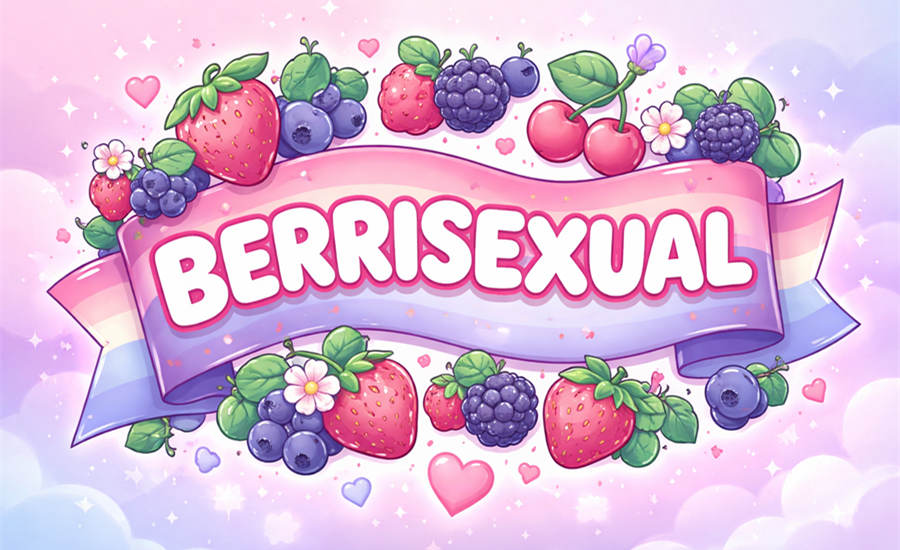
Berrisexual Meaning, Simply Explained
The simplest way to understand berrisexual is this: it describes a pattern of attraction that is multi-gender, but not evenly distributed. Someone who uses the label may feel attraction to more than one gender, yet notice that the strongest romantic or sexual pull tends to go in one direction more than others.
In most current definitions, that stronger pull is toward feminine-aligned and androgynous people. Attraction to men or masculine-aligned people may still be possible, but it may feel rarer, lighter, more situational, or less central to the person’s overall experience. That unevenness is a big part of what the label is trying to name.
For many readers, this is what makes the term click. A broader label may feel close, but still a little too wide. Someone may know they are not only attracted to one gender, while also knowing that their attraction does not feel equally open in every direction. Berrisexual gives language to that middle ground.
That does not mean everyone needs this level of specificity. Some people are perfectly comfortable with a broader label and do not feel any need to narrow it further. But for others, a more precise word can feel relieving. It can make their experience feel easier to describe without having to add a long explanation every time.
Where Did the Term Berrisexual Come From?
Berrisexual is part of a newer wave of identity language that has grown mostly through online LGBTQ+ spaces rather than older clinical or academic terminology. That is one reason it can feel unfamiliar at first. It is not a label many people grew up hearing, and it is still much more common in internet-based identity conversations than in mainstream resources.
That newer origin also helps explain why the term can feel flexible around the edges. Microlabels often spread through community use before they become widely known or consistently defined. People encounter them on social platforms, in queer forums, through personal essays, or in community-made glossaries long before they appear in larger public conversations.
More broadly, labels like this tend to appear because attraction is not always easy to describe with older umbrella terms alone. Sometimes a broader word is enough. Sometimes it is not. Newer labels usually catch on because they help some people describe a pattern they have felt for a long time but did not know how to put into words.
How Berrisexual Is Different From Bisexual, Pansexual, and Omnisexual
Berrisexual vs bisexual
Bisexual is often used as a broad umbrella term for attraction to more than one gender. That umbrella is intentionally wide, which is one reason it remains useful to so many people. As the APA notes in its overview of different degrees of attraction, bisexuality does not require attraction to every gender to look identical, feel equally strong, or show up in the same way over time.
Berrisexual can fit under that broader umbrella, but it usually adds more shape and specificity. Instead of only saying attraction includes more than one gender, it points to a more noticeable pattern within that attraction. The person may recognize that their strongest pull tends to center feminine-aligned and androgynous people, while attraction to men or masculine-aligned people feels lighter, less frequent, or less emotionally central.
That is why the difference is often not about contradiction, but detail. Someone may feel that bisexual is true in the broadest sense, while berrisexual feels more accurate when they want to describe how their attraction actually works in real life.
Berrisexual vs pansexual
Pansexual is often understood as attraction that is not limited by gender, or attraction where gender is not the main barrier. For many people, the label carries a sense of openness across genders without building a clear preference into the meaning itself.
Berrisexual usually feels narrower than that. It does not just say attraction can cross gender lines. It usually describes attraction that has a pattern or lean. Gender and presentation still matter in how attraction is felt, and the attraction may consistently gather around certain people more than others.
That distinction matters for readers who feel that “attraction regardless of gender” sounds too broad or too even for their experience. Someone may know they are capable of attraction across genders and still feel that the way attraction shows up is far from neutral. In that case, berrisexual may feel more precise than pansexual.
Berrisexual vs omnisexual
Omnisexual is often used by people who are attracted to all genders while still recognizing gender as part of attraction. Because of that, it may sound closer to berrisexual than pansexual does.
The main difference is usually one of emphasis and pattern. Omnisexual can describe attraction across genders with awareness that gender plays a role. Berrisexual tends to go a step further by naming that the attraction is not only gender-aware, but also unevenly weighted. In other words, it is not just that gender is noticed. It is that attraction tends to lean more strongly toward certain presentations and less strongly toward others.
For someone who feels attraction across genders but also notices a repeated center of gravity in who draws them most strongly, berrisexual may feel more exact. Omnisexual may still feel right for some people, but berrisexual often speaks more directly to the imbalance in attraction rather than attraction across all genders in general.
Can someone use more than one label?
Yes. Identity language is not always one-word-only, and many people use labels at different levels of specificity. A broader label may feel easier in everyday conversation, while a more specific label may feel more honest in personal reflection or in queer spaces where nuance is easier to explain.
That does not make either label less real. In practice, someone might say bisexual because it is familiar, then use berrisexual when they want to describe the pattern inside that broader identity more clearly. Labels often work in layers, and that flexibility is part of what makes them useful.
What Berrisexual Can Look Like in Real Life
In real life, this may show up less like a rule and more like a pattern someone notices over time. A person might realize that most of their crushes, relationships, or strongest attractions tend to center women, feminine-aligned people, or androgynous people, even though attraction to men is not completely absent.
For someone else, the difference may show up emotionally rather than statistically. They may be capable of attraction across genders, but notice that the attraction does not carry the same depth, consistency, or romantic pull in every direction. That can be hard to explain with a broad label alone, especially if they keep feeling like the fuller truth needs one more sentence attached to it.
That is often where berrisexual becomes useful. It does not create the pattern; it simply gives the pattern a name. And like many identity labels, it may feel very right for one person and not quite right for another, even if their experiences overlap in some ways.
Is Berrisexual a “Real” Sexuality?
This question usually carries a lot more emotion than it first appears to. When people ask whether a label is real, they are often asking whether it deserves to be taken seriously. A good answer is that berrisexual is real in the way identity language is real: people are using it because it describes something meaningful about how their attraction works.
It may be newer, more niche, and less widely recognized than terms like bisexual or pansexual. But unfamiliar does not automatically mean invalid. Language around sexuality has always evolved, and not every useful label starts out in the mainstream.
For readers who are still sorting through what fits, it can help to step back from the pressure to land on one perfect word and spend a little time with broader sexual orientation questions. Sometimes that wider context makes a newer label easier to place.
The Bottom Line on Berrisexual Meaning
Berrisexual is a newer microlabel typically used for attraction that can include more than one gender, but leans more strongly toward feminine-aligned and androgynous people rather than feeling evenly balanced across the board.
For some people, that nuance matters because it feels more accurate than a broader label. For others, a broader word may still feel simpler and more natural. Both can be valid. The point is not to force attraction into a perfect category. It is to find language that feels honest enough to be useful.