The phrase equally yoked shows up often in Christian conversations about love, dating, and marriage, but it can still feel a little vague. Most people want a simple answer: what does it mean, and how does it apply to real relationships? At its core, being equally yoked means two people share the same spiritual foundation and are moving in the same direction. That matters because faith shapes values, decisions, priorities, and the kind of life a couple builds together.
What Does Equally Yoked Mean?
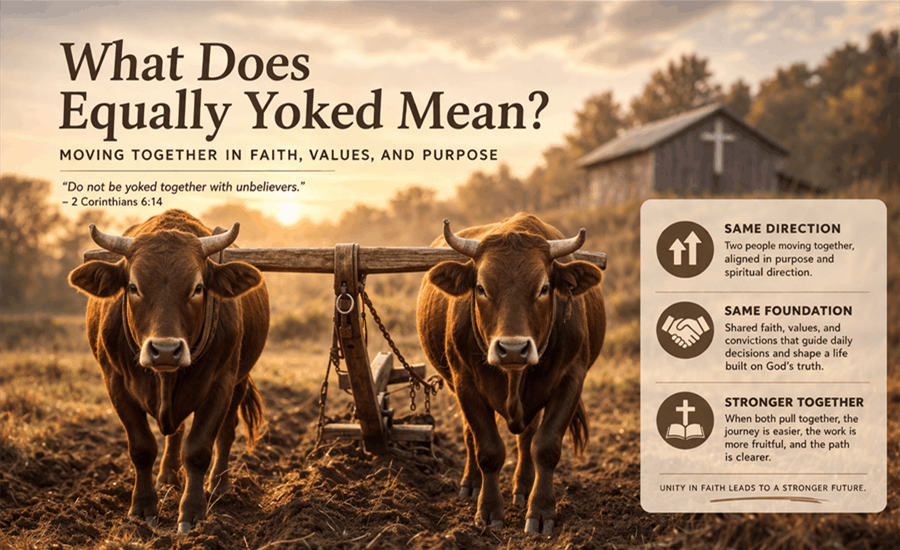
The image behind this phrase comes from farming. A yoke was a wooden bar placed over two animals so they could pull a load together. For that to work well, both animals needed to move in the same direction and at the same pace. If one pulled harder, moved slower, or kept drifting off course, the work became harder for both.
That picture helps explain the heart of the phrase. In relationships, being equally yoked means two people are joined closely and pulling in the same direction, especially in what matters most. For Christians, that usually points to shared faith, shared values, and a shared sense of purpose.
It does not mean two people have to be exactly alike. They can have different personalities, different strengths, and different backgrounds. The key issue is deeper than personality. It is about whether they are built on the same spiritual foundation.
Where Does the Phrase Come From in the Bible?
The idea comes from 2 Corinthians 6:14, where Paul tells believers not to be unequally yoked with unbelievers. The passage itself is broader than romance, but it clearly speaks to close spiritual alignment. That is why Christians so often apply it to dating, marriage, and other deeply binding relationships.
It also helps to be careful here. The verse does not directly give a modern dating checklist. Still, the principle is easy to see: when two people are joined closely but grounded in very different beliefs, tension often follows. That is why this verse continues to shape Christian thinking about relationships today.
Why This Matters in Real Life
This is not only about a Bible phrase. It is about everyday life.
The person you build a future with will affect how you make decisions, how you handle conflict, what kind of home you create, how you view money, what you believe about sex and commitment, and how you want to raise children. Those things may not feel urgent at the start of a relationship, but they become very real over time.
Attraction, chemistry, and kindness matter. Of course they do. But they are not enough to carry a relationship through every season. When life gets serious, deeper questions rise to the surface. What guides us? What matters most? What kind of future are we really trying to build? That is where spiritual alignment becomes hard to ignore.
Does Being Equally Yoked Apply to Dating?
Many Christians believe it does, even though 2 Corinthians 6:14 does not mention dating by name. The reason is simple: dating is often a step toward marriage. If marriage calls for deep spiritual unity, then dating choices matter too.
At first, spiritual differences can seem manageable. Maybe the relationship feels easy, the person is kind, and the connection is strong. It is tempting to think shared feelings will cover everything else. But once a relationship becomes more serious, those differences often become clearer.
Questions start to matter more. Will faith be a real part of your relationship, or only your private life? Will you worship together? Will you agree on sexual boundaries? Will you see church as a priority? If children come later, what will you teach them?
This is where many people realize that love and spiritual unity are not the same thing. You can care deeply about someone and still be heading in different directions. That does not mean the relationship was fake. It means the foundation may not be as shared as it first seemed.
What Does Equally Yoked Mean in Marriage?
Marriage brings even more weight to this idea because it joins two lives at the deepest daily level. Marriage is not just shared feelings. It is shared decisions, shared pressures, shared routines, shared hopes, and often shared parenting.
Faith affects all of that. It shapes how people define commitment, how they respond to hardship, how they practice forgiveness, and what kind of home they want to build. When two spouses are grounded in the same faith, they have a stronger center to return to when life feels heavy.
That does not mean an equally yoked marriage is a perfect marriage. Christian couples still face conflict, stress, disappointment, and weakness. But spiritual unity gives them a shared place to stand. They are not trying to build the same life from two completely different foundations.
Signs You May Be Equally Yoked
There is no perfect checklist, but some signs are usually clear.
One sign is that both people take faith seriously in real life, not just in name. Another is that they share core beliefs about God, Scripture, and what it means to follow Jesus. They may not agree on every small issue, but they are rooted in the same center.
Another healthy sign is that conversations about faith feel natural. You can talk honestly about church, prayer, convictions, and the future without one person shutting down or brushing it off. Faith is not an awkward topic that only shows up during conflict.
It also matters that your direction is shared. You want the same kind of home. You care about similar values. You picture a future shaped by the same spiritual priorities. Even if one person is more mature or expressive than the other, the overall direction still lines up.
Signs You May Not Be Equally Yoked
Sometimes the warning signs are obvious. Other times they are quiet enough to excuse away.
Maybe one person sees faith as central while the other treats it like a side detail. Maybe prayer, church, biblical values, or moral choices keep creating friction. Maybe hard conversations about the future never go far because the deeper differences feel too uncomfortable to face.
Another common sign is false hope. One person may keep telling themselves that things will change later, that faith will become more important to the other person, or that marriage will somehow close the gap. But a relationship built on future change instead of present truth can become painful very quickly.
It is also possible for two people to both say they are Christian and still not be truly aligned. A label alone does not always reveal the depth of a person’s faith. One may be growing and committed, while the other is only loosely attached to faith as a background identity.
Can Two Christians Still Be Unequally Yoked?
Yes, they can.
This is an important part of the conversation because it moves beyond surface labels. Two people may both identify as Christian, yet still live with very different priorities, convictions, and patterns. One may want a relationship shaped by prayer, obedience, and spiritual growth. The other may like the label of Christianity without wanting faith to guide real decisions.
That difference matters. Being equally yoked is not just about sharing a word. It is about whether faith is active, real, and influential in both lives. In other words, it is possible to match on paper and still be far apart in practice.
What Should You Do If You Realize You Are Not Equally Yoked?
Start with honesty. Do not minimize deep differences just because the relationship feels meaningful. A relationship can be caring, close, and emotionally strong while still being spiritually misaligned.
Then ask clear questions. Are these differences small, or do they shape the direction of your life? Are you accepting reality, or only hoping things will change? Are you at peace, or are you always trying to explain away the same tension?
After that, have a real conversation. Talk openly about faith, values, church, marriage, and the future. Not in vague terms. Be direct. It is far better to face hard truth now than to carry quiet conflict into a more serious commitment later.
It also helps to pray for wisdom and seek counsel from mature believers you trust. When emotions are strong, it can be hard to see clearly on your own. Wise outside perspective can help you slow down, think clearly, and make a healthier decision.
What If You Are Already Married but Not Equally Yoked?
This situation is different, and it should be handled with grace.
If someone is already married to an unbelieving spouse, 1 Corinthians 7:12–16 speaks to that situation. The focus there is not panic or shame. It points toward faithfulness, peace, and steady witness within the marriage.
That matters because some people hear teaching on being equally yoked and immediately feel regret or fear about the life they are already living. But if you are already married, the goal is not to live under constant guilt. The goal is to walk faithfully where you are, love well, pray consistently, and seek wisdom for the relationship you have now.
You cannot force spiritual change in another person. You cannot control their heart. But you can live your faith with patience, truth, and grace. That kind of steady witness matters more than many people realize.
Equally Yoked Is About More Than Romance
Even though this phrase is most often used for dating and marriage, the principle can also apply more broadly to other close partnerships. The more serious, binding, and directional a relationship is, the more alignment matters.
That does not mean Christians should avoid every friendship or connection with people who believe differently. Not at all. But when a relationship has the power to shape your future in deep ways, shared spiritual direction becomes much more important.
Final Thoughts on Being Equally Yoked
Being equally yoked is not about finding a perfect person. It is about shared spiritual direction. It is about whether two people are trying to build life from the same center, with the same deepest loyalty and the same understanding of what matters most.
That is why this topic matters so much. A relationship can look strong on the outside and still feel strained at the core if the foundation is divided. Shared faith does not remove every problem, but it does give a couple a stronger place to stand when life becomes hard.
If you are thinking through this in your own life, do not rush the question. Slow down. Be honest. Pay attention to direction, not just emotion. In the long run, spiritual unity is not a small detail. It is one of the things that can bring greater peace, clarity, and lasting strength to a relationship.