The Web of Wyrd is one of those symbols that instantly feels meaningful. Its woven lines suggest fate, connection, and the sense that life follows patterns we do not always understand right away. If you have seen it in Norse-inspired art or symbolism, you have probably wondered what it actually means and whether it is truly ancient. The short answer is that the idea behind it reaches back to older beliefs about fate, even though the familiar symbol itself is most likely modern.
What Is the Web of Wyrd?
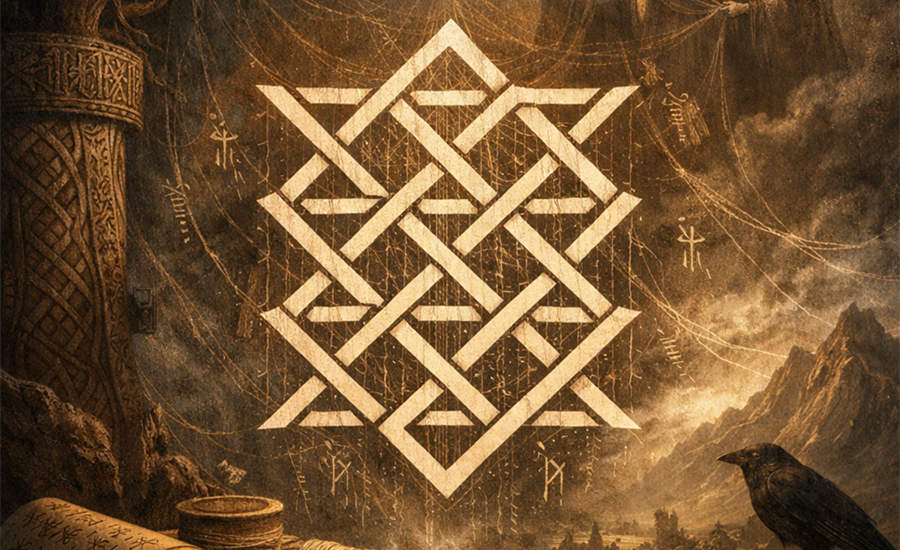
The Web of Wyrd is usually shown as a pattern of intersecting lines arranged in a grid-like form. In modern interpretation, it represents fate, interconnectedness, and the way past, present, and future shape one another. Rather than treating life as a series of separate moments, the symbol suggests that everything belongs to a larger weave.
That idea is a big part of its appeal. The symbol does not frame life as random or isolated. It points to the belief that choices, losses, relationships, timing, and turning points all become part of a wider pattern. Even when life feels confusing, the Web of Wyrd offers an image of hidden structure.
Many modern versions use nine lines or a nine-part structure, which is one reason the symbol is often linked to Norse themes. The number nine matters in Norse mythic tradition, but it is still important not to overstate the point. What people usually mean by the Web of Wyrd today is a modern symbolic design used to express older ideas about destiny and connection, not a clearly documented Viking Age emblem.
Web of Wyrd Meaning in Norse Thought
To understand the symbol, it helps to begin with the word wyrd. In Old English, wyrd is often translated as fate or destiny, but the feeling behind it is richer than that simple definition. It carries the idea of what comes to pass, what unfolds, and what takes shape over time. That makes it less like a rigid script and more like the ongoing formation of a life.
This is where the symbol becomes especially interesting. In the worldview people connect with the Web of Wyrd, fate is not only about the future. It is also about consequence, inheritance, memory, and becoming. What happened before matters. What is happening now matters too. Life is not separate from time; it is made inside it.
That is why the Web of Wyrd is often used to represent interconnected lives rather than passive destiny. It suggests that events do not stand alone. What you choose, what you lose, what you survive, and what you carry forward all belong to the same pattern. The symbol captures the feeling that life is woven, not scattered.
For modern readers, this usually feels more personal than abstract. It turns fate into something lived rather than something distant. Instead of saying, “Everything is fixed,” it suggests something more thoughtful: life is shaped through linked moments, and every strand touches another.
The Web of Wyrd and the Norns
The symbol is also closely tied to the Norns, the female figures in Norse tradition associated with fate. In modern explanations, they are often described as shaping or weaving the destinies of gods and people. That image of weaving is one reason the Web of Wyrd feels so fitting, even if the graphic itself is modern. The symbol visually expresses an idea that already existed in older mythic thought: fate is formed through threads, not straight lines.
The Norns are also part of why the symbol is so often linked to time. Modern readers frequently connect them with past, present, and future, and that interpretation has become one of the most familiar ways of understanding the Web of Wyrd. Whether someone approaches the symbol through mythology, spirituality, or personal reflection, the same core idea tends to return: life is shaped by what has already happened, what is unfolding now, and what is still becoming.
Seen this way, the Web of Wyrd is less about prediction and more about continuity. It does not promise that the future is neatly readable. Instead, it suggests that the future grows out of existing strands. The present is never isolated from the past, and the future is never born from nothing.
Is the Web of Wyrd an Ancient Norse Symbol?
This is the part many articles rush through, but it is really the part that makes the topic clearer. The ideas people connect with the Web of Wyrd do have older roots. Fate, weaving, the Norns, and the sense that lives are bound into a larger order all belong to the wider Germanic and Norse tradition. But the familiar line-based symbol most people now call the Web of Wyrd is best understood as a modern creation inspired by those older ideas.
That distinction matters. A lot of online writing blurs the line between an old belief and a new symbol. The result is an article that sounds mystical but leaves the reader with the impression that the exact design comes straight from the Viking Age. That is not the most careful way to frame it. The concept is older than the graphic.
Once that is clear, the topic actually becomes more interesting. The symbol does not lose meaning just because it is modern. If anything, it shows how older ideas continue to be reimagined in ways people still connect with today. The Web of Wyrd works because it gives visual form to a worldview that has long associated fate with weaving, order, and time.
So the most accurate way to describe it is this: the Web of Wyrd is a modern symbol inspired by older Norse and Germanic ideas about destiny. That framing is both more honest and more useful than calling it a direct Viking Age emblem.
What the Web of Wyrd Symbol Represents Today
In modern use, the Web of Wyrd usually stands for more than fate alone. It often represents interconnectedness, life patterns, resilience, acceptance, and the belief that nothing exists in complete isolation. Some people see it as a reminder that even painful experiences still belong to a larger story. Others are drawn to it because it reflects the feeling that life has meaning even when it feels difficult to read in the moment.
That is why the symbol often feels quiet rather than dramatic. It is not usually treated as a sign of conquest, luck, or protection in the direct way some other symbols are. Its power is more reflective. It speaks to timing, consequence, and the understanding that life unfolds through layers rather than simple answers.
For many people, that is exactly what makes it memorable. The Web of Wyrd does not flatten life into a single message. It leaves room for complexity. It suggests that strength can come from change, that meaning may only become visible in hindsight, and that every life is shaped by more than one moment alone.
Web of Wyrd vs Other Norse Symbols
The Web of Wyrd is often grouped with other Norse or Viking-related symbols, but it carries a different tone from many of them. Vegvisir, for example, is usually presented as a symbol of guidance or finding one’s way. The Web of Wyrd is more about the weave of destiny and the structure of time. One points toward direction; the other points toward connection.
The Valknut feels different again. Its linked triangular form is more directly associated with older Norse imagery and is often connected with death, transition, and Odin-related symbolism. The Web of Wyrd, by contrast, is usually interpreted through fate, continuity, and interwoven lives.
That difference matters because readers often encounter these symbols together and assume they mean roughly the same thing. They do not. Even when they live in the same visual world of Norse-inspired symbolism, they carry distinct emotional and historical associations.
Conclusion
The Web of Wyrd is widely understood today as a symbol of fate, connection, and the way time weaves every part of life together. Its meaning draws on older ideas about destiny, the Norns, and the shaping of human lives, but the familiar graphic itself is best treated as a modern expression of those themes rather than a clearly attested ancient Norse sign.
That balance is exactly what gives the symbol its lasting pull. It feels ancient in spirit, even if its current form is newer. And for many people, that is enough. The Web of Wyrd offers a thoughtful way to picture life as something layered, connected, and still unfolding.