
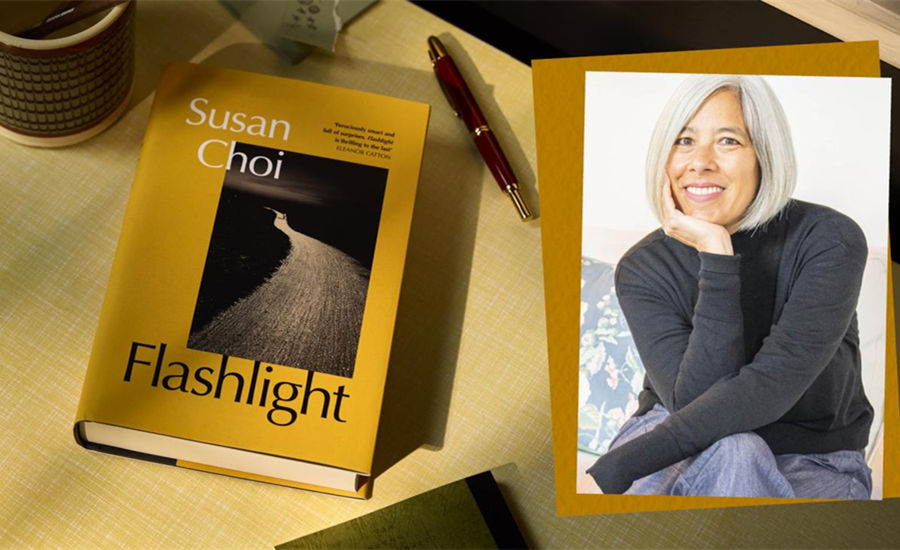
Flashlight by Susan Choi opens with a disappearance, but the novel is really about what lingers after it: family rupture, memory, identity, and the quiet weight of unanswered questions. It is literary fiction with emotional depth, moving across time and distance without losing sight of the people at its center.
If you are searching this book, you are probably trying to figure out what kind of reading experience it offers. Flashlight is thoughtful, layered, and melancholic, more interested in emotional truth than quick payoff.
What Is Flashlight by Susan Choi About?
Flashlight opens with a deeply unsettling event. Ten-year-old Louisa is found washed ashore after being out near the water with her father, Serk, who disappears. That loss becomes the emotional center of the novel, but the book is not built as a simple mystery. It is far more interested in what happens after the event itself: how absence changes a family, how memory shifts over time, and how people keep living around questions that never fully resolve.
As the novel unfolds, it expands beyond a single moment of tragedy. The story moves across years, places, and generations, showing how one rupture continues shaping identity and relationships long after the original shock. Choi turns the father’s disappearance into more than a plot point. It becomes a way of exploring what families inherit, what they misunderstand, and what remains unreachable even between people who love one another.
What Kind of Reading Experience Does Flashlight Offer?
Quiet, layered, and emotionally intense
This is not a novel driven by dramatic twists or constant movement. Its power comes from accumulation. Choi builds meaning through atmosphere, interior tension, and emotional detail, which gives the book a steady, immersive quality. Even when very little seems to happen on the surface, the novel is full of pressure underneath.
That quiet intensity is one of the book’s strongest qualities. Flashlight trusts mood, silence, and implication. It asks the reader to pay attention not only to events, but to what those events leave behind in the minds and bodies of the people who survive them.
A novel that asks for patience
Flashlight unfolds gradually. It does not hurry to explain its characters, and it does not rush toward emotional closure. Instead, it lets meaning gather over time, which makes the reading experience feel reflective and layered. Readers who enjoy literary fiction that deepens slowly will likely appreciate that pace. Readers hoping for a more immediate payoff may find it demanding.
Still, that patience feels purposeful. A novel so concerned with memory, distance, and unresolved grief would lose something if it moved too quickly. Choi allows uncertainty to remain part of the experience, and that gives the story more emotional truth.
Why the emotional atmosphere matters so much
What lingers most in Flashlight is its atmosphere. The novel feels hushed, unsettled, and quietly haunted by what cannot be recovered. Even in calmer passages, there is a sense that something essential has slipped out of reach. That emotional texture matters because it shapes the entire reading experience.
This is the kind of novel where tone does as much work as plot. The sadness, distance, and searching quality of the book are not background elements. They are central to the way the novel creates meaning and leaves its impression.
What Themes Shape Flashlight?
Family as both intimacy and distance
One of the novel’s most compelling ideas is that family can hold closeness and estrangement at the same time. The people who know one another best are not always the people who understand one another best. Choi writes family life as a space of love, loyalty, silence, and misreading, where emotional bonds remain strong even when understanding breaks down.
That tension gives the novel much of its weight. Parents and children do not only pass down affection. They also pass down fear, confusion, expectation, and unfinished pain. Flashlight captures the way family history keeps shaping a person long after the original wounds seem buried.
Memory and the instability of truth
Memory is one of the novel’s deepest concerns, and Choi treats it as something fragile rather than reliable. People remember selectively. They shape the past into forms they can live with. They inherit stories in fragments and build meaning from what is missing as much as from what is known.
That gives the novel a subtle but powerful tension. Truth in Flashlight is never just about facts. It is also about perspective, time, feeling, and the limits of what one person can ever know about another. The book understands that family stories rarely arrive whole. They come in pieces, and those pieces do not always fit neatly together.
Identity, belonging, and cultural dislocation
Flashlight also explores the experience of living across places, histories, and inherited identities. Its characters are shaped not only by family relationships, but by migration, language, cultural memory, and the feeling of existing between worlds. Choi handles these questions with restraint, keeping them grounded in lived experience rather than turning them into abstract statements.
That makes the novel feel broader without losing its intimacy. Identity here is not treated as a label. It is something shaped by family, geography, absence, naming, and the longing to belong fully somewhere. The novel suggests that identity is rarely simple, especially for people whose lives are formed across different countries, histories, and emotional legacies.
Loss that lingers instead of ending cleanly
Many novels use loss as a dramatic event. Flashlight treats it as an ongoing condition. Serk’s disappearance is not confined to the opening of the story. It continues to shape how the family remembers, relates, and understands itself. The loss does not settle. It changes form and keeps moving through the lives of those left behind.
That is what gives the novel its lasting ache. Choi is interested in unresolved grief, the kind that becomes part of a person’s emotional structure rather than something they move neatly beyond. The sorrow in Flashlight is quiet, but it is deeply woven into the book’s sense of selfhood and time.
What Stands Out Most About Susan Choi’s Writing in Flashlight?
Susan Choi writes with great control. Her prose is elegant and deliberate, but it never feels sterile. She does not force intensity or overexplain emotion. Instead, she allows tension to gather slowly, which gives the novel a deeper and more lasting effect. The writing feels attentive, confident, and emotionally intelligent.
What stands out most is the balance she achieves between intimacy and scope. Flashlight remains rooted in private feeling, yet it reaches outward into larger questions about history, belonging, and inheritance. The result is a novel that feels both personal and expansive without losing coherence.
Choi is also especially skilled at restraint. She understands that what is withheld can be as powerful as what is spoken outright. That makes the novel feel quietly pressurized from beginning to end. It rarely needs to raise its voice to leave an impression.
Is Flashlight an Easy Book to Read Emotionally?
Not really, though that difficulty is part of the novel’s strength. Flashlight is emotionally heavy not because it is sensational, but because it stays close to unresolved pain. It lingers in family rupture, emotional distance, and the way grief can continue shaping a life long after the first moment of loss.
Readers who are drawn to introspective literary fiction may find that emotional weight deeply rewarding. Others may find the novel more melancholic than expected. This is not a comforting book in any simple sense. It asks for patience, attention, and emotional openness.
At the same time, it is never empty or flat in its sadness. Choi gives her characters real interior depth, which keeps the novel rich and absorbing. The emotional difficulty of Flashlight comes with substance. It leaves a mark because it is thoughtful, not because it is dramatic for its own sake.
Final Thoughts on Flashlight by Susan Choi
Flashlight by Susan Choi is a searching, emotionally layered novel about what remains when certainty disappears. It takes a single family rupture and turns it into a broader reflection on memory, identity, inheritance, and the long reach of unresolved loss. The story moves across time and place, but its emotional force remains intimate throughout.
What makes the novel stand out is its patience. Choi does not rush the reader toward easy understanding. She allows the book’s meanings to emerge slowly, which makes its final effect feel deeper and more lasting. For readers curious about the book’s broader literary reception, its 2025 Booker Prize shortlist page adds helpful context without pulling attention away from the novel itself.
Featured Image Source: https://thebookerprizes.com/the-booker-library/features/an-extract-from-flashlight-by-susan-choi