
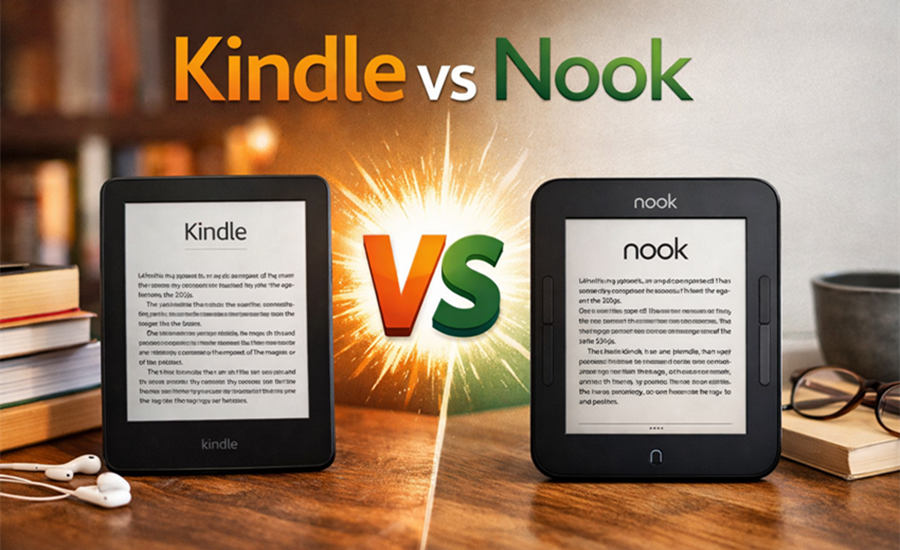
Trying to choose between a Kindle and a NOOK can feel oddly personal. On paper, both are e-readers. In real life, they offer two different reading experiences. Kindle gives you a bigger ecosystem, more device options, and more feature variety. NOOK keeps things simpler and more bookish, which is exactly why some readers still love it. If you are torn between the two, the real question is not just which device looks better. It is which one fits the way you actually read.
Kindle vs NOOK: The biggest difference
The biggest difference between Kindle and NOOK is ecosystem. Kindle is part of a much larger Amazon reading universe with more hardware tiers, more upgrade paths, and more extras built around digital reading. NOOK is more focused. Its lineup is smaller, its identity is more closely tied to Barnes & Noble, and its appeal is less about doing everything and more about giving readers a straightforward place to read.
That difference matters more than any single spec. If you like having options and room to grow, Kindle makes a lot of sense. If you want an e-reader that feels calm, familiar, and centered on books instead of features, NOOK has a charm that is easy to understand.
Device lineup differences: Kindle gives you more choice
Kindle clearly wins on variety. Amazon’s current Kindle lineup includes the basic Kindle, the Kindle Paperwhite, the Kindle Colorsoft, and the Kindle Scribe. That means you can start with a simple reading device, move up to a more premium waterproof model, choose a color e-reader for comics and illustrated books, or go for a larger writing-friendly device that doubles as a digital notebook.
NOOK is different. Its dedicated e-reader lineup is smaller and easier to understand, with models like the NOOK GlowLight 4e, GlowLight 4, and GlowLight 4 Plus. That narrower range can actually be a plus if you hate overthinking tech purchases. You are not choosing between a dozen versions of the same idea. You are choosing between a few devices that are all clearly built for reading first.
Still, the tradeoff is obvious. Kindle gives you more flexibility. NOOK gives you less decision fatigue. Whether that feels freeing or limiting depends entirely on what kind of shopper you are.
Reading experience differences: NOOK feels more tactile
For pure reading comfort, both brands do the essentials well. They are designed for glare-free reading, long battery life, and a softer experience than reading on a phone or tablet. But the feel of using them is not exactly the same.
Kindle tends to feel more touch-first and more polished across different price tiers. Amazon’s lineup gives readers multiple screen sizes and feature sets, so it is easier to match a device to your budget and habits. If you want warm lighting, waterproofing, or a bigger display, Kindle gives you more ways to get there without leaving the brand.
NOOK stands out in a different way: physical page-turn buttons. The GlowLight 4e, GlowLight 4, and GlowLight 4 Plus all support turning pages with buttons instead of relying only on swipes. That may sound like a small detail, but it can make a real difference if you read in bed, read one-handed, or simply love the feel of a more tactile reading device.
This is one of the most practical differences in the whole comparison. Kindle often feels sleeker. NOOK often feels a little more old-school in a good way. If you want your e-reader to disappear into the background, page-turn buttons can be surprisingly persuasive.
Bookstore and ecosystem differences: Kindle feels bigger, NOOK feels more contained
Kindle feels like the bigger ecosystem because it is. Amazon has expanded Kindle into a broader digital reading platform, with multiple device categories and a subscription layer through Kindle Unlimited. Amazon says Kindle Unlimited gives members access to more than 5 million digital books, along with thousands of audiobooks, comics, manga, and magazines. If you read widely and like the idea of one large reading universe, Kindle makes that easy.
NOOK feels more contained, but not in a bad way. Barnes & Noble says readers can access their NOOK Library on bn.com, in the NOOK app, and on NOOK devices. So the ecosystem still follows you across screens. It just feels more bookstore-centered and less expansive than Amazon’s approach.
This is where personal preference starts to matter. Some readers want the biggest platform with the most options. Others would rather stay in a smaller, more focused reading space. Kindle is stronger on scale. NOOK is stronger on simplicity and brand familiarity.
Feature differences: Kindle has more room to grow with you
If you want more than basic e-reading, Kindle pulls ahead fast. Kindle Colorsoft gives Amazon a true color e-reader, which matters for comics, graphic novels, cookbooks, and any book where color adds something meaningful. Kindle Scribe goes even further by blending reading with handwriting, note-taking, and document markup.
That does not mean everyone needs those extras. In fact, a lot of readers do not. But it does mean Kindle offers a clearer upgrade path if your habits change. You can start simple and later realize you want waterproofing, a larger screen, color, or writing tools without switching ecosystems.
NOOK is more restrained. That restraint can feel like a strength if you mostly want a device for novels, memoirs, and everyday reading. Barnes & Noble also highlights audiobook support on the NOOK GlowLight 4 Plus, including Bluetooth and a headphone jack. But overall, NOOK is still the more focused option, while Kindle stretches further into premium and specialty features.
Library borrowing differences: NOOK is clearer, Kindle is more conditional
Library borrowing is one of the most important differences for budget-conscious readers. Barnes & Noble states that all NOOK devices support public library borrowing. That is a simple, reassuring promise, and it makes NOOK especially appealing if library reading is a big part of how you use an e-reader.
Kindle can also work very well for library books, but the process is more conditional. OverDrive says Kindle books for libraries are available for U.S. libraries only, and readers typically send eligible titles to their Kindle after borrowing them through their library’s digital catalog. For many American readers, this works beautifully. But it is not quite as universal or as cleanly stated as Barnes & Noble’s NOOK message.
So the difference is not that one supports libraries and the other does not. It is that NOOK presents library borrowing as a built-in all-devices strength, while Kindle’s library experience depends more on region and title availability. If you borrow constantly, that distinction is worth paying attention to.
Waterproofing and premium comfort: model matters more than brand
One place shoppers sometimes get confused is waterproofing. This is not a simple Kindle-versus-NOOK win. It depends on the model. Amazon highlights waterproofing on the Kindle Paperwhite, while Barnes & Noble highlights an IPX7 waterproof design on the NOOK GlowLight 4 Plus. In other words, both brands offer good options for bath, beach, and poolside readers, but you need to choose the right device.
This is a good example of why the comparison works best when you think about lifestyle first. If you want an entry-level e-reader for casual reading, waterproofing may not matter much. If you read everywhere and treat your e-reader like a daily companion, it can absolutely be worth paying for.
Which one is easier to use?
For most people, Kindle will probably feel easier in the long run simply because Amazon has a bigger, more mature reading ecosystem. The device range is broader, the services are more layered, and the overall experience is built to keep everything connected.
At the same time, NOOK can feel easier in a different way. It asks less of you. There are fewer device choices, fewer feature rabbit holes, and a more focused sense of what the device is for. If you are shopping for someone who is not especially techy, that simplicity can be a selling point.
So the real answer is this: Kindle is easier if you want the most integrated ecosystem. NOOK is easier if you want less noise and fewer decisions.
Kindle vs NOOK: Which one is better?
For most readers, Kindle is the stronger overall buy. It has the broader lineup, the deeper feature set, the bigger ecosystem, and the clearest path if you want to upgrade later. It is the safer recommendation for the average shopper because it gives you more ways to find the version of reading that suits you best.
But NOOK is not an outdated second choice. It still makes a lot of sense for readers who want a simpler e-reader, prefer Barnes & Noble, borrow library books often, or care deeply about physical page-turn buttons. In those everyday, practical ways, NOOK still feels distinct.
If you want more options, go with Kindle. If you want a more focused reading experience and love the idea of tactile page turns, NOOK is still well worth considering. That is the real difference, and it is the one that matters most.